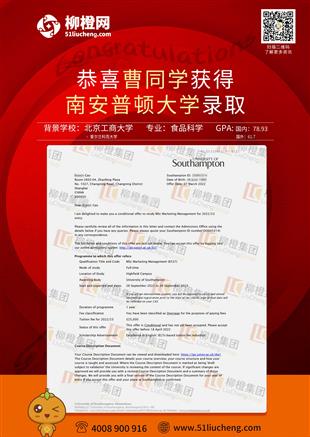

申請(qǐng)人員:曾同學(xué)
申請(qǐng)?jiān)盒#?/span>紐卡斯?fàn)柎髮W(xué)
申請(qǐng)專業(yè):International Political Economy MA
簡(jiǎn)介:Economics is in the top five for graduate starting salaries, reflecting the value that employers place on a subject that they see combining the skills of the sciences and the arts. Although it is lower for overall employment rates, the subject is still comfortably in the top 20. Its reputation as a highly marketable degree helped economics to withstand the impact of higher fees in 2012. Applications were only slightly down on the previous year and close to the top ten in terms of popularity. Not surprisingly, competition for places is stiff, with more than six applications for every degree place. Many prospective students underestimate the mathematical skills required for an economics degree. Most of the leading universities demand maths at A level, or its equivalent, as part of offers that are consistently high. Entry standards in this year’s table reflect that, with four of the top five universities all averaging over 550 points – the equivalent of more than four As at A level and another at AS level. Another dozen have averages of at least 450 points, while only one of the 68 institutions in the ranking averages less than 200 points. Oxford has regained the lead it lost last year to Cambridge, although the highly competitive nature of this ranking means that it does not lead on any single indicator. Cambridge has the highest entry standards and the best employment record, but an unusually low student satisfaction score (for Cambridge, at least) relegates it to fifth place this year. Both Oxford and Cambridge were eclipsed by the second-placed London School of Economics (LSE) and also by University College London, in fourth, in the 2008 Research Assessment Exercise. The most satisfied students are at Kent and Surrey, although there were good scores throughout the table. Plymouth, for example, is only two percentage points off the top score and has become the leading post-1992 university, but still does not make the top 40. Glasgow remains the leading university in Scotland, a fraction of a point ahead of Edinburgh, while Cardiff has a comfortable lead in Wales. Almost three economists in ten continue studying after their first degree, either full or part-time. Starting salaries in graduate jobs had risen only slightly at the time of the latest survey, but the £16,237 average for other types of employment is among the highest for any subject.以下是2013年times英國(guó)大學(xué)排名經(jīng)濟(jì)學(xué)專業(yè)排名。
|
51

|
阿伯里斯特維斯大學(xué)Aberystwyth University |
查看詳情 測(cè)試我的申請(qǐng)成功率 |
|
52

|
諾丁漢特倫特大學(xué)Nottingham Trent University |
查看詳情 測(cè)試我的申請(qǐng)成功率 |
|
53

|
考文垂大學(xué)Coventry University |
查看詳情 測(cè)試我的申請(qǐng)成功率 |
|
54

|
赫特福德大學(xué)University of Hertfordshire |
查看詳情 測(cè)試我的申請(qǐng)成功率 |
|
55

|
西英格蘭大學(xué)University of the West of England,Bristol |
查看詳情 測(cè)試我的申請(qǐng)成功率 |
|
56

|
布魯內(nèi)爾大學(xué)Brunel University |
查看詳情 測(cè)試我的申請(qǐng)成功率 |
|
57

|
布拉德福德大學(xué)University of Bradford |
查看詳情 測(cè)試我的申請(qǐng)成功率 |
|
58

|
阿爾斯特大學(xué)University of Ulster |
查看詳情 測(cè)試我的申請(qǐng)成功率 |
|
59

|
倫敦城市大學(xué)City University London |
查看詳情 測(cè)試我的申請(qǐng)成功率 |
|
60

|
斯塔福德郡大學(xué)Staffordshire University |
查看詳情 測(cè)試我的申請(qǐng)成功率 |
|
61

|
伯明翰城市大學(xué)Birmingham City University |
查看詳情 測(cè)試我的申請(qǐng)成功率 |
|
62

|
倫敦都市大學(xué)London Metropolitan University |
查看詳情 測(cè)試我的申請(qǐng)成功率 |
|
63

|
密德薩斯大學(xué)Middlesex University |
查看詳情 測(cè)試我的申請(qǐng)成功率 |
|
64

|
金斯頓大學(xué)Kingston University |
查看詳情 測(cè)試我的申請(qǐng)成功率 |
|
65

|
利物浦約翰摩爾斯大學(xué)Liverpool John Moores University |
|
66
.jpg)
|
曼徹斯特城市大學(xué)Manchester Metropolitan University |
查看詳情 測(cè)試我的申請(qǐng)成功率 |
|
67
|
東倫敦大學(xué)University of East London |
查看詳情 測(cè)試我的申請(qǐng)成功率 |
|
68

|
利茲城市大學(xué)Leeds Metropolitan University |
查看詳情 測(cè)試我的申請(qǐng)成功率 |



掃一掃
關(guān)注柳橙
關(guān)于柳橙| 聯(lián)系我們| 法律聲明| 加入我們| 網(wǎng)站地圖| 友情鏈接
Copyright ?2011-2026 柳橙網(wǎng) 版權(quán)所有
自費(fèi)出國(guó)留學(xué)中介服務(wù)機(jī)構(gòu)資格認(rèn)定
柳橙網(wǎng)為上海留成網(wǎng)信息技術(shù)股份有限公司(原上海駿文投資咨詢有限公司)所有

滬公網(wǎng)安備 31010502007205號(hào)
滬ICP備11045181號(hào)-4